


Living and designing my new home in Japan, I have grown to love wabi sabi style. Whilst it can appear to be similar, it’s not to be confused with Japandi design which is generally a lot cleaner and more minimal, comprising of elements from both Japanese and Scandinavian design.
Wabi Sabi is very much about embracing the imperfect nature of items, bringing far more interest and a tactile feel to a room. It leans heavily on natural elements to ground a room in a soft and endearing manner, feeling cosy, liveable and calm.
I’ve pulled together 17 different ways to incorporate this loved style in your living room, with a contemporary twist for today.
17 Wabi Sabi Living Room Ideas For A Calm, Interesting Space
1.Soft, Ambient Lighting
No one creates soft, layered lighting schemes quite like the Japanese. Teamed with floaty curtains and a private feel, soft, layered lighting is embraced to avoid a room feeling clinical or harsh. So, step away from those downlights!
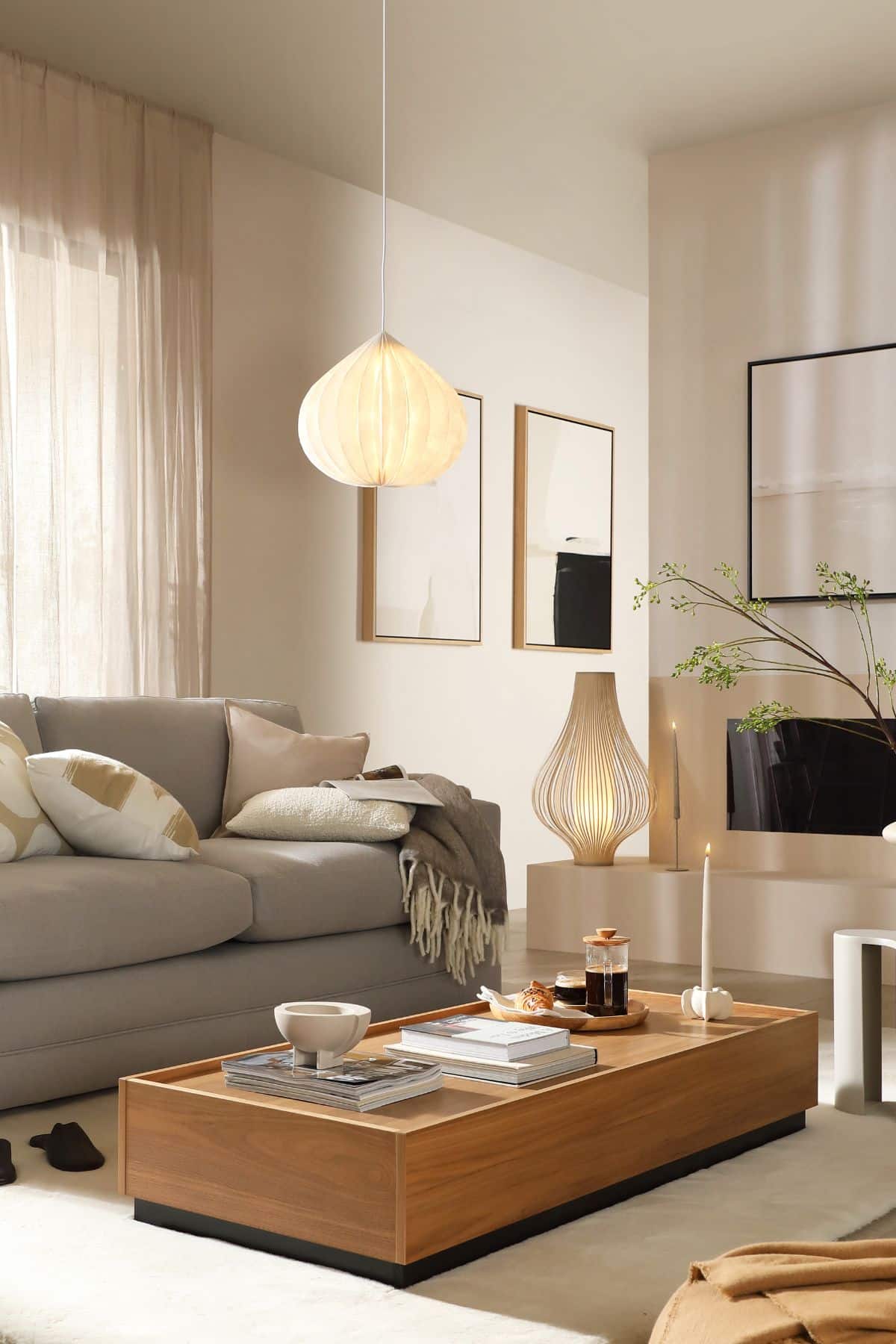
Lighting choices with paper pendants such as the one below are a popular choice, as they beautifully diffuse the light they emit, leading to a softer overall look.
Do layer with a floor lamp, table lamp and candles so you can adjust the lighting in a flexible manner when required.
2. Use of Natural Materials
Similar to earthy interior design, wabi sabi is grounded on the use of natural materials as they give their true, organic look in an interior.
The use of wood, granite, stone, glass and even marble should be welcomed into a living room design. Granite and stone are popular choices as they balance against the warmer tones often used on wall coverings and they deliver much more unusual and unexpected textures through their original form.

3. Wood Plays An Integral Role
Japanese design heavily uses wood through its design, and it’s no different in wabi sabi design. An organic form that brings life and a sense of calm to a living room, it’s hard to ever feel bad when surrounded by real wood.
Lift the eye up and create a focal feature with a wooden ceiling. This type of ceiling has been used for decades in traditional tatami rooms, they bring such a wonderful sense of calm, and coolness to a room.

4. Perfectly Imperfect Decor
If you draw anything from creating a true wabi sabi style, it is that you must embrace the imperfect nature of objects. It’s what makes them most endearing, perhaps a misshapen pot, a cracked vase that has been restored by the art of kintsugi, or your favourite large pot that has become chipped and worn over the years.
The extra layers and textures tell a story, they hold the eye a little bit longer and they completely shape a wabi sabi living room.
5. Soft & Muted Colours
Japandi style is typically very clean and white in style, but wabi sabi uses much more colour, whilst still soft and muted to create that calm ambience.
Peachy tones, plaster look colours, cream limestone, browns and greens and softer takes on earthy colours should all be considered in a living room scheme. You may also see the use of black a lot which just helps to ground a scheme, alternatively you can use natural stone or charcoal tones of grey for a softer approach.

6. Wabi Sabi Artwork
Whilst you should keep artwork and decor to a minimum, artwork can help to fill otherwise empty walls, and draw the eye in as you step into the living room.
There are so many different types of wabi sabi artwork on the market, but having a go at creating your piece of artwork is not only inexpensive, but it will deliver that imperfect look we’re trying to achieve.
Playing around with muted colours and using something for texture such as shikui plaster or filler can help to build up texture and uneven details for interest.

7. Rely On Real Greenery
The only design trend where you can’t fake it until you make it, leave faux plants at the door! Only real houseplants and greenery should be used here so you can benefit from the organic colours, textures and imperfections which you don’t get from fake plants.
Consider scaling up with a large potted plant, and use a mixture of sizes in a living room, benefitting from the colour and air purifying benefits of plants.

8. Combine A Mixture of Materials For A Tactile Feel
It’s all about interest, layering and creating different textures in a wabi sabi scheme, it doesn’t all need to be perfectly polished!
Natural elements are an easy way to achieve this, think of things such as linen curtains, a seagrass basket, a paper lantern and fringed cushion. They add warmth, interest and a tactile feel to those sitting within the room.

9. Embrace Natural, Dappled Sunlight
The Japanese are experts at creating moody, ambient rooms with diffused lighting, but allowing natural, dappled lighting to pass through into the space creates those interesting, shape shifting silhouettes and enhances the calm feeling in a living room.
This can be achieved with linen curtains that can be drawn and pulled when required to adjust the ambience, and the use of glass lighting and objects which allow light to pass through them uninhibited.

10. Floor To Ceiling Length Curtains
A key design feature in wabi sabi living rooms is the use of floor to ceiling length voile curtains. They’re floaty, natural and still allow light to pass through, whilst diffusing the intensity of it.
Built in tracks to the ceiling crate that flawless drop to the ground, but if you don’t have them in your design plans, focus on installing a black curtain pole as high up the wall as possible, it will create a better drop and make the room feel bigger than it is.

11. Focus On Shape
Unusual shapes and combining both angular and curved lines are characteristic in wabi sabi design. It’s easy to achieve in a living room with perfectly formed tub chairs, tactile bowls and smooth, curved decor designed for wabi sabi environments.
Mixing up straight and curved lines engages the eye in a different way, and it keeps things interesting, as is what is intended with wabi sabi interior design.

12. Add Definition With A Dark Wood
Everything always goes back to wood, and dark, defining wood is one of the best ways to ground a living room naturally without having to use a solid dark colour in the space.
It’s cosy, endearing and sets the precedence in this living room below so well.

13. Make The Ceiling Interesting
Whilst British homes typically have a very normal and flat ceiling, you’ll often see in Japanese homes that the party starts on the ceiling.
Additional texture is used, wood is employed, and they often have a style of coffered ceiling, adding depth between the outer border and inner part of the ceiling. Don’t just consider a bog standard white paint, whether through renovating and adding in wooden panels or wallpapering it instead, the fifth ceiling is there to have fun with, and experiment!

14. Scale Up
Scaling up will forever be my greatest interior design tip to anyone, its a universal design trick to make a room more elevated, and when it comes to foliage displays in wabi sabi design, it’s everything.
Just make sure you use a large enough pot or vase to get the desired look, focus on huge stems, or branches from your garden like the below. But do remember to change it up seasonally which is so important with wabi sabi style.

15. Less Is More
Well lived in Japanese homes are quite the contrary, but wabi sabi embraces the less is more philosophy. Everyday items are stored away in actual, well organised spaces and decor is to a minimum.
You don’t need to place decor on every surface, instead lean into the white space surrounding objects, and only use select items that fill a void well, engage the eye visually in different perspectives.

16. Low Furniture
We often see a lot of lower furniture in wabi sabi design, letting large artwork and other elements in the room draw the eye up.
It gives the eye less to fight over when you step into a room, creating a much calmer, organised design scheme.

17. Stand Out Ceiling Light
The fifth wall is one to have fun with, and using the lighting as an opportunity to focus the eye as you step into the room is key.
Rule number 1 is to always scale up, no matter how big or small the room is, you almost always want to go bigger than you first thought. It might feel counterintuitive in a small room, but it will actually make the room feel bigger.
Then consider form and texture, the below light fitting ticks all the boxes, it’s textured, draws the eye in and you ponder on it for longer enjoying the crisp turns and shadows of the material.
Wabi Sabi is such a beautiful design style for a living room, if you have any other questions about using it in your own home, please leave me a comment below!

